New Age of ZanzibART
3 young artists from Zanzibar,Tanzania
Hashim Abdi
Salum Muchi
Asaa Hamad
Part 1
Gallery TOMOS
1996.3.25(Mon)--4.3(Wed)
11:00am--6:30pm
*3.25 from 3:00pm to 5:00pm
Watanabe Buil B1, 1-3-1 Nihombashi-honcho Chuoh-ku Tokyo
3.30(Sat) From 2:00pm We have discussion with Mr.Hashim about
"Tanzania art scene"
*3.31(Sun) Closed
Part 2
Gallery 21+YOH
1996.3.25 (Mon)--3.30 (Sat)
11:30am--7:00pm *3.30 to 5:00pm
Chery Buil B1, 3-4-17 Ginza Chuoh-ku Tokyo
Part 3
Shohmeidou Hall
1996.4.6 (Sat)--4.17(Wed)
11:00am--7:00pm
Shohmeidou B1, Near the Takanodai Stn. Kodaira Tokyo
4.14(Sun) From 3:00pm Mr.Hashim tells "Me and Shetani, Swahili
spirit cult complex"
3 Young artists from Zanzibar
Our three young artists came from Zanzibar, a small but populous
island with a population of 400,000, set in the Indian Ocean. It is
the fourth largest city in the United Republic of Tanzania, well
known for Mt.Kilimanjaro and Ngorongoro Natural Park, a paradise of
wild animals in a huge crater. The people of Zanzibar had already
started trading with Arabs since 8 century. Their close relationship
with the Arab makes the peculiar character of their culture
different from the inland areas of Tanzania. The three artists we
welcome now teach at Nyumba ya Sanaa , a national arts and crafts
school founded in 1987 with the help of Japan Overseas Cooperation
Volunteers. All of them are in their twenties with short careers as
serious artists, but perhaps because of their youth and
inexperience, they have produced works of rare beauty, showing their
confidence in art and the pleasure of creation.
Hashim Abdi (b.1969)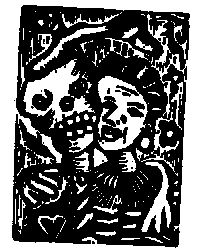
Among the three, only Hashim visits Japan, invited to the
award ceremony of The 3rd Sapporo International Print Biennale, as a
winner of the silver prize. Though 96 percent of Zanzibari are
Muslim, the folk religion still persists among them. The heroes and
heroines of the folklore, "Shetani" (from the same root as "Satan")
are the dead, but they are believed to be enjoying a life like ours.
They are capricious and mischievous toward us and can be seen only
by sensitive people, or only when we become highly sensitive. Hashim
continues drawing on the narratives of Shetani like a sorcerer, and
he says it is natural and quite the same as drawing on his everyday
life. Surely he is not a socerer by any means, but an ordinary young
Zanzibari, loving reggae and Whitney Houston.
Asaa Hamad (b.1969)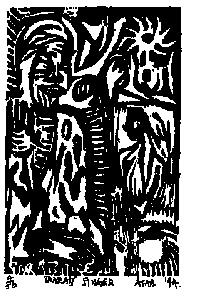
It is not well known that Zanzibar was governed by the sultan of
Oman from the seventeenth century until 1964 (however, from 1896
onwards, the United Kingdom exercised effective control), the year
of the revolution. "Taarb", the unique pop music of Zanzibar came
from the court music of the sultan and has come to express true
sentimentality of the common people. The concerts are popular
especially among Muslim women who go rarely out of their home. Taarb
gives them an occasion to dress up and congregate, and represents
their true voices. Assa takes up as his themes Taarb concerts and
its rhymes, most of which deal with love. However, his drawings are
ironically decorative and reminiscent of the interior ornaments of
Islamic mosque.
Salum Muchi (b.1967)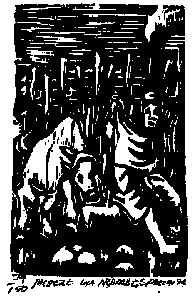
Muchi the oldest of them and can be called the leader of the group.
He is a kind of story-teller about the common people's lives, having
silently drawn on various scenes of everyday life: festivals,
weddings, often sorcerers rituals. These traditional events have
gradually disappeared or changed in the modernization of Zanzibar.
Muchi also depicts tumultuous markets or outside disco parties that
are very familiar to young Zanzibari. In his prints, we can
certainly see how Zanzibar is now, how a region of Africa is now.
ARAI Shin-ichi (Artist, ex-Teacher of Nyumba ya Sanaa, Zanzibar)
-----------------------------------------------------
The 3rd Sapporo International Contemporary Print Biennial
March 22 (Fri) – April 7 (Sun), 1996
Hokkaido Museum of Modern Art
International Contemporary Print Biennial: No Grand Prize Awarded;
Two Artists—Including Abdi from Tanzania—Receive Semi-Grand
Prizes
The results of the "Sapporo International Contemporary Print
Biennial"—the largest international print exhibition in Japan—were
announced on the 10th.
For this third edition, 3,033 works were submitted by 1,256 artists
from 76 countries. No work was deemed worthy of the Grand Prize;
instead, Semi-Grand Prizes were awarded to Hashim Abdi (26)
from Tanzania and Xu Zhongmin (34)—a Chinese national
residing in the UK—both of whom are male.
In addition, 144 works were selected for the exhibition, 46 of which
were created by Japanese artists. An exhibition featuring the
winning and selected works will be held at the Hokkaido Museum of
Modern Art from March 22 to April 7, 1996.
(November 11, 1995, Yomiuri Newspaper [Tokyo edition], morning
issue, page 38, Society section)
back to ARAIart.jp